

III. Accumulation amid Distress
In the previous two parts we saw that the corporate sector and the banks are sitting on a mountain of cash, and refusing to invest, for lack of demand; on the other hand, vast numbers of working people are facing distress, and are resorting to borrowing to meet their basic needs.
Paucity of demand is one of the underlying features of India’s economy, arising from its basic structure. In the absence of basic social and economic change, demand will remain stunted and distorted. On this base of stunted and distorted demand, euphoric surges of growth do take place from time to time, triggered by one or the other abnormal phenomenon. The last such episode, during 2003-08 (and again from 2009-11) left a deep impression on India’s business tycoons. They keep harking back to the boom of the first decade of this century as if that were the ‘new normal’, and the slump since 2011 were the aberration; but the reverse is the case.
The Government has staked much on the growth of exports as the driver of overall growth. In 2014, it announced the ‘Make in India’ programme; this was re-branded in 2020 as Atmanirbhar Bharat in the wake of Covid-19, when the Government hoped to attract multinationals who were said to be leaving China. The Atmanirbhar package included the Production Linked Incentives scheme, whereby selected large industrial producers in specified industries (at present 14 industries) would be provided subsidies on the value of incremental sales. The idea was to promote large Indian firms or conglomerates as ‘national champions’, who would command the resources to make themselves internationally competitive.
However, this programme has not shown results: India’s goods exports have stagnated for the last decade at between 1.6 and 1.8 per cent of world exports, and that share is reported to have actually declined in 2024. There is also little sign that India’s biggest conglomerates are trying to compete internationally. At any rate, given the current global uncertainty centered on international trade, with India’s largest export destination (the US) putting extraordinary pressure on India, the hope of powering the growth of India’s economy through exports is dim. What then is the solution for the corporate sector?
Attempts to boost corporate profit, at the cost of the people
Since India’s large capitalists find there is inadequate demand to warrant investment in expanding production, they seek other methods of accumulation – such as speculation, land acquisition, privatisation, State subsidies (including tax concessions), State-controlled contracts for infrastructure or weaponry, and so on. In all these the role of the State as their handmaiden is crucial. Importantly, these methods boost corporate demand at the cost of the rest of the economy and its people – hence at the cost of aggregate demand. Below we take some instances of this.
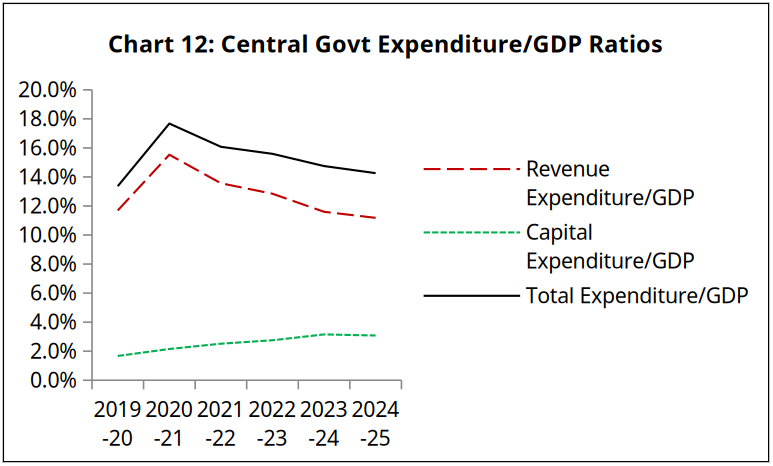
1. Shift in Government expenditure: Government expenditure can stimulate demand. But India’s Central government is reducing its total expenditure as a percentage of GDP, in order to satisfy the demands of international credit ratings agencies such as Standard & Poor and Moody’s. At the same time it is increasing its capital expenditure (spending on certain types of infrastructure) in order to boost demand for a section of the corporate sector.
How has it increased capital expenditure while reducing total expenditure? The Central government has sharply reduced what is called its ‘revenue expenditure’ as a percentage of GDP (see Chart 12). But it is revenue expenditure (in the form of salaries, welfare expenditures, subsidies, etc) that comes directly into people’s hands. So the reduction of revenue expenditure as a proportion of GDP further dampens overall demand in the economy.
As a result of this pattern of spending (more for the corporate sector, less for the people) the production of infrastructure/construction goods is growing much faster than the production of consumer non-durables (i.e., manufactured items of ordinary mass consumption such as food products, medicines, soap, detergent, toothpaste, tea powder, paper, and so on), as shown in Chart 13.

It is true that any Government expenditure creates some demand. However, the major recipient of Government capital spending is the private corporate sector (in the form of infrastructure contracts). When demand is not growing, the private corporate sector may think it wiser to simply pocket the profits of such Government expenditure, not expand production. By contrast, the entire income that comes to the working people gets spent; this in turn leads to further growth of demand (the ‘multiplier effect’). So a shift of Government expenditure from revenue expenditure to corporate sector-oriented capital expenditure can lead to a reduction in overall demand even if total Government expenditure remains the same.
2. Ousting of other producers: A second method can boost the top segment of the corporate sector, even if the market as a whole stagnates or shrinks. That top segment can maintain the size of its market by ousting smaller competitors. In this, Government policy measures such as demonetisation in 2016, the imposition of the GST system in 2017, and the Covid lockdown in 2020-21 have helped the large corporate sector by eliminating a large number of small firms. A 2022 study estimated that the sales of smaller firms, with capital of less than Rs 5 crore, had shrunk by 14 per cent since the pandemic.1 There appears to have been some revival of small firms since then, but the losses suffered in that period have left their scars. The workforce in the informal manufacturing sector shrank by almost 5 million between 2015-16 and 2022-23.2
3. Corporate capture of health, education, conveyance: In order to boost corporate demand, the Government is systematically privatising public services, and this directly impinges on the consumption of the people. The Corona package promoted and subsidised private investment in ‘social infrastructure’ (education and healthcare). The effect of such reforms is not to expand the market for education and healthcare, but to hand over a larger share of it to the private corporate sector. Take one example, the public-private partnership (PPP) scheme for hospitals, ostensibly to upgrade them and build medical colleges. As reported by Rema Nagarajan in the Times of India, “Thousands of crores worth of public hospital buildings built over decades of investment to strengthen the public health system and several lakh crores worth of public land are either in the process of being handed over or have already been given to private entities across India.”
This process of partnering with the private sector received a push in 2017 when the central government and Niti Aayog, in consultation with the World Bank, recommended operating government hospitals with 300 or fewer beds and setting up medical colleges under the PPP mode. In 2020, the Centre unveiled its viability gap funding scheme, under which it would provide 30%-40% of the capital expenditure for private entities to set up such colleges and the state government would provide another 30%-40%. It further recommended 25% each from Centre and state for the operation and maintenance cost of each project for the first five years. Niti Aayog has been pushing PPPs for running dialysis units, cardiac care and oncology departments and diagnostics, and there has been an explosion of such PPPs across India.3
Privatisation means an end to free outpatient consultation and diagnostics. While a small proportion of beds are meant to be kept aside as free beds, this is so only on paper. At any rate the bulk of beds are to be paying beds. This leads to a hike in medical costs for individuals: In rural areas, the costs of hospitalisation in private hospitals is six times higher than public hospitals; in urban areas, eight times higher.4
These processes have been underway for some time, and their effects are visible. During the period of liberalisation, the share of monthly per capita expenditure spent on health has risen. A recent study, citing data of a large household survey, shows that between 2014 and 2017-18, Indian households’ health-related spending rose twice as fast as their overall spending.5 As a result, health-related spending would have taken a greater share of total spending. And with increasing privatisation, this process is set to intensify.
The education sector has been undergoing a similar process of privatisation, and public transport is being silently replaced with private transport (such as two-wheelers). Significantly, the combined expenditures on education, health and conveyance are around three times the expenditures on clothing, bedding and footwear.6 As expenditure on privatised services has grown, it would have pre-empted a larger share of the incomes of working people, leaving less for spending on mass-consumption industrial goods.
4. Capture of land and natural assets: The Central government has also taken steps to hand over large swathes of land and associated natural resources to the corporate sector. As part of its Corona package, it liberalised private investment in coal (allowing extraction without specifying end-use) and minerals. It made sweeping changes to environmental laws to allow post-facto clearances (effectively legalising illegality), and to prevent any public questioning of, or opposition to, environmental clearances. More recently, the Central government amended the Forest Conservation Act, 1980 so as to effectively nullify the Forest Rights Act of 2006, and facilitate the corporate grabbing of forest land.7 It rammed through various projects, such as the Adani acquisition of land in the Hasdeo forest of Chhattisgarh for coal mining. All these measures devastate the subsistence livelihoods of the people of these regions.
Indeed, the regions richest in mineral resources in India are also the poorest. Chhatisgarh, Odisha and Jharkhand, which have the highest mineral wealth per capita, also have the lowest monthly per capita expenditure (see Chart 14). During the period of liberalisation, the gap between the income levels of the mineral-rich states and other states has widened. Within the mineral-rich states a small elite has benefited: The gap between the incomes of tribals and non-tribals widened in all states, but it widened the most in the mineral-rich states.8
Chart 14: Monthly Per Capita Expenditure of Different States and Mineral Value Per Capita (2012)

As Amit Bhaduri argues, with the capture of land, forest and natural resources by corporate firms, output may rise despite a fall in employment (output per worker in the corporate sector is 12 times that in agriculture); the composition of output itself changes, catering to demand from those with more purchasing power; and the accumulation of wealth is greatly accelerated. Indeed, he remarks, “It opens a far more effective way for corporations to acquire more wealth in a shorter period than profit from production would have made possible.”9
At the same time, these processes devastate livelihoods and further depress the consumption of the people further.
In conclusion
To conclude: India’s economy has long been marked by an underlying problem of demand. From time to time, there have been euphoric surges of growth, owing to one or the other temporary factor. In such periods, large domestic capitalists have been able to rapidly accumulate wealth. But after these surges have petered out, the problem of demand has come to the fore once again.
One of the solutions to the demand problem is export-oriented growth. Even if we ignore the problems inherent to this model, it is explicit that successive Governments’ efforts to promote exports of manufactured goods have yielded very poor results. In the present world situation, India’s exports are not going to drive India’s growth.
Faced with this impasse, large capitalists demand that the State revive the accumulation process for them by hook or crook. The Government could increase its spending, a decision which, unlike the case of private consumption or private investment, is in its own hands. However, in the current period of ‘liberalisation’ and globalisation, Government spending has been increasingly constrained by the dictates of international financial capital, which does not approve of increased Government spending.10 This shuts off an established method of relieving the demand problem. The State’s attempts to boost demand by fueling growth of bank credit are fruitless, because large capitalists have little need of credit (as they see no profit in expanding production).
The State therefore turns to predatory measures, predating on the people to help the large capitalists accumulate wealth. But by eating into the incomes of the people and undermining or destroying their very livelihoods, the State winds up actually restricting demand even further. In this way, the process is internally contradictory; leading to another round of shrinking demand.
This is why the corporate sector’s pockets are stuffed with cash, and the banks are groaning with a surfeit of funds, even as investment, the engine of growth, has come to a halt.
- P. Bhandari and A. Chaudhary, HSBC Research, November 2022, cited in Viral Acharya, “India at 75: Replete with Contradictions, Brimming with Opportunities, Saddled with Challenges”, Brookings Papers on Economic Activity, March 2023. ↩︎
- National Sample Survey, 73rd Round, and Annual Survey of Unorganised Sector Enterprises, 2022-23. ↩︎
- Rema Nagarajan, “PPP = Transfer of hospitals built with public money into private hands”, Times of India, July 10, 2025. ↩︎
- Ibid. ↩︎
- In nominal terms, i.e., without discounting for inflation, per capita spending rose by 53 per cent in the rural areas, and 41 per cent in the urban areas; but per capita spending on health rose 97 per cent in rural areas and 93 per cent in urban areas. Indranil Mukhopadhyay, Montu Bose, and Rahul S. Reddy Kadarpeta, “Contested Claims: Making Sense of the Decline in Out-of-pocket Expenditure”, Economic & Political Weekly, September 6, 2025. The data is of the Consumer Pyramids Household Survey (CPHS) carried out by the Centre for Monitoring the Indian Economy (CMIE). ↩︎
- National Sample Survey, Household Consumption Expenditure Survey 2023-24. As the survey methodology has changed from 2022-23 on, we are unable to compare expenditures over time. ↩︎
- Kanchi Kohli and Manju Menon, “Environmental regulation and post-Covid 19 economic recovery”, November 24, 2020, Heinrich Böll Stiftung,
https://in.boell.org/en/2020/11/24/environmental-regulation-and-post-covid-19-economic-recovery ↩︎ - Economic Survey 2016-17, vol. I, p. 293. We do not, however, consider this ‘internal colonialism’, though some have argued this. Internal colonialism suggests that some other regions within India benefit at the expense of the colonised regions, which is not the case. The extraction of natural resources from underdeveloped regions benefits a small class domestically and international capital. ↩︎
- Amit Bhaduri, “Danger Zones of High Economic Growth”, EPW, October 22, 2016. ↩︎
- The reasons international investors oppose an increase in Government spending need to be explained separately, but in essence, by suppressing domestic demand in India, international investors are able to capture the maximum gain from their investments here. ↩︎